

Single Point Detectors
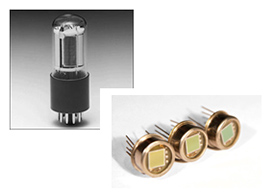
HORIBA offers a comprehensive array of single point detectors for a wide variety of applications in spectroscopy and biomedical research. These are complete detectors including housings, power supplies and facility for cooling if necessary. Available on a stand-alone basis, or in conjunction with our monochromators and spectrographs these detectors allow you to configure a custom solution for your unique requirements. Many of our spectrographs have dual exit ports allowing you to have both a point detector for ultimate resolution and a multi-channel imaging spectrograph for high speed spectral acquisitions. HORIBA offers more choices and better specifications to ensure you can select the best components for your needs.
Photomultiplier Detectors
Photomultiplier Detectors | Detector Material | Wavelength Range (nm) | Active Area, mm | Dark Current (nA) | Cooling | Chopper & Lock-In or Modulated Source |
|---|---|---|---|---|---|---|
Multialkali Photocathode | 185 to 900 | 8 x 24 | 3 | RT or TE | Not Required | |
Multialkali Photocathode | 160 to 900 | 8 x 24 | 3 | RT or TE | Not Required | |
Bialkali Photocathode | 185 to 650 | 8 x 24 | 0.1 | RT or TE | Not Required | |
InGaAs Photocathode | 185 to 1010 | 3 x 12 | 1 | TE | Not Required |


1 Dual detectors consist of a silicon detector on top of a NIR detector, where the Silicon transmits wavelengths above 1 μm
RT = Room Temperature
TE = Thermoelectric cooling
LN2 = Liquid nitrogen cooling
Solid State Detectors
Solid State Detectors | Detector Material | Wavelength Range (μm) | Active Area, mm | Sensitivity (D*) | Cooling | Chopper & Lock-In or Modulated Source |
|---|---|---|---|---|---|---|
Silicon (Si) | 0.20 to 1.10 | 2.5 mm Ǿ | 1.48E+14 | RT | Not Required | |
Silicon (Si) | 0.20 to 1.00 | 2.5 mm Ǿ | 2.22E+14 | TE | Not Required | |
Indium gallium arsenide (InGaAs) | 0.80 to 1.70 | 2 mm Ǿ | 3.54E+13 | RT | Not Required | |
Indium gallium arsenide (InGaAs) | 0.80 to 1.65 | 2 mm Ǿ | 1.18E+14 | TE | Not Required | |
Indium gallium arsenide (InGaAs) | 0.80 to 1.55 | 2 mm Ǿ | 1.77E+15 | LN2 | Not Required | |
InGaAs Extended | 1.00 to 2.05 | 1 mm Ǿ | 8.86E+12 | TE | Recommended | |
InGaAs Extended | 1.00 to 1.90 | 1 mm Ǿ | 4.43E+13 | LN2 | Recommended | |
InGaAs Extended | 1.20 to 2.40 | 1 mm Ǿ | 1.77E+12 | TE | Recommended | |
InGaAs Extended | 1.30 to 2.20 | 1 mm Ǿ | 8.86E+12 | LN2 | Recommended | |
Germanium (Ge) | 0.80 to 1.80 | 2 mm Ǿ | 3.94E+12 | RT | Not Required | |
Germanium (Ge) | 0.80 to 1.60 | 2 mm Ǿ | 3.54E+13 | TE | Not Required | |
Germanium (Ge) | 0.80 to 1.50 | 2 mm Ǿ | 7.09E+14 | LN2 | Not Required | |
Lead sulfide (PbS) | 1.00 to 2.80 | 2 x 2 | 1.00E+12 | RT | Required | |
Lead sulfide (PbS) | 1.00 to 2.80 | 2 x 2 | 6.67E+12 | TE | Required | |
Lead selenide (PbSe) | 1.00 to 4.50 | 2 x 2 | 2.00E+10 | RT | Required | |
Lead selenide (PbSe) | 1.00 to 4.50 | 2 x 2 | 1.00E+11 | TE | Required | |
Mercury cadmium telluride (HgCdTe) | 1.00 to 5.00 | 2 x 2 | 1.00E+11 | TE | Required | |
Indium antimonide (InSb) | 1.00 to 5.40 | 2 mm Ǿ | 1.20E+11 | LN2 | Recommended | |
Mercury cadmium telluride (HgCdTe) | 2.00 to 14.00 | 2 x 2 | 4.00E+11 | LN2 | Required | |
Mercury cadmium telluride (HgCdTe) | 2.00 to 20.0 | 2 x 2 | 6.67E+10 | LN2 | Required |
1 Dual detectors consist of a silicon detector on top of a NIR detector, where the Silicon transmits wavelengths above 1 μm
RT = Room Temperature
TE = Thermoelectric cooling
LN2 = Liquid nitrogen cooling
Pyroelectric Detector
Pyroelectric Detector | Detector Material | Wavelength Range (μm) | Active Area, mm | Sensitivity (D*) | Cooling | Chopper & Lock-In or Modulated Source |
|---|---|---|---|---|---|---|
Lithium tantalate (LiTaO3) | 2.00 to 16.00 | 2 mm Ǿ | 1.77E+09 | RT | Required |
1 Dual detectors consist of a silicon detector on top of a NIR detector, where the Silicon transmits wavelengths above 1 μm
RT = Room Temperature
TE = Thermoelectric cooling
LN2 = Liquid nitrogen cooling
Solid State Dual Detectors1
Solid State Dual Detectors1 | Detector Material | Wavelength Range (μm) | Active Area, mm | Sensitivity (D*) Si / IR Material | Cooling | Chopper & Lock-In or Modulated Source |
|---|---|---|---|---|---|---|
Si over Ge | 0.20 to 1.80 | 2 mm Ǿ | 1.48E+14/2.36E+12 | RT | Recommended | |
Si over Ge | 0.20 to 1.60 | 2 mm Ǿ | 2.22E+14/2.13E+13 | TE | Recommended | |
Si over InGaAs | 0.20 to 1.70 | 2 mm Ǿ | 1.48E+14/2.13E+13 | RT | Recommended | |
Si over InGaAs | 0.20 to 1.65 | 2 mm Ǿ | 2.22E+14/7.09E+13 | TE | Recommended | |
Si over InAs | 0.20 to 3.50 | 2 mm Ǿ | 1.48E+14/5.32E+9 | RT | Recommended | |
Si over InAs | 0.20 to 3.40 | 2 mm Ǿ | 2.22E+14/1.06E+11 | TE | Required | |
Si over PbS | 0.20 to 2.80 | 2 mm Ǿ | 1.48E+14/6.00E+11 | RT | Required | |
Si over PbS | 0.20 to 2.80 | 2 mm Ǿ | 2.22E+14/4.00E+12 | TE | Required | |
Si over PbSe | 0.20 to 4.50 | 2 mm Ǿ | 1.48E+14/1.20E+10 | RT | Required | |
Si over PbSe | 0.20 to 4.50 | 2 mm Ǿ | 2.22E+14/6.00E+10 | TE | Required |
1 Dual detectors consist of a silicon detector on top of a NIR detector, where the Silicon transmits wavelengths above 1 μm
RT = Room Temperature
TE = Thermoelectric cooling
LN2 = Liquid nitrogen cooling
Detectors from 200 nm to 20 µm
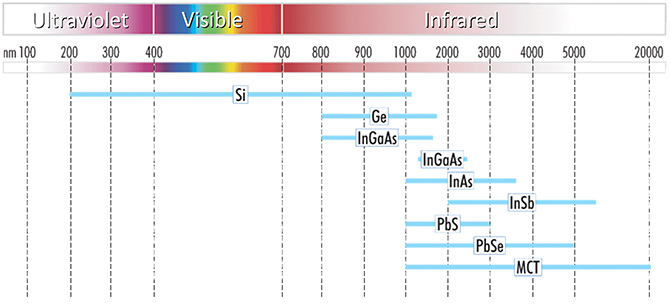
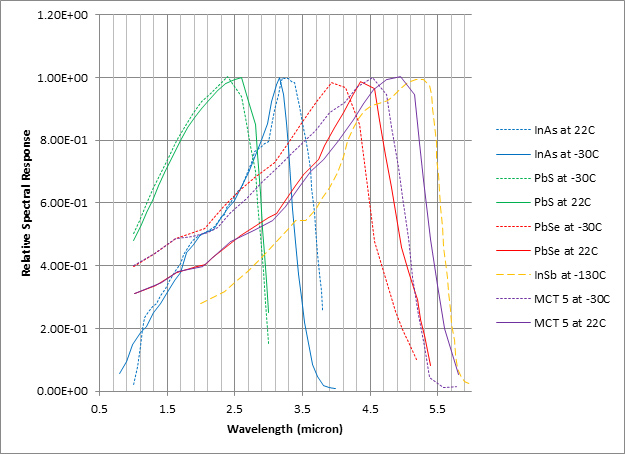
Single Point Detectors Spectral Response
PMT Housings
A variety of ambient and cooled PMT housings are available for both stand-alone use and for efficient optical coupling with HORIBA spectrometers.
Housing | Application | Integrated | Cooling |
|---|---|---|---|
Spectrometer coupling | No | Ambient | |
Spectrometer coupling | Yes | Ambient | |
Stand-alone | Yes | Ambient | |
Spectrometer coupling | No | TE water cooling | |
Spectrometer coupling | No | TE air cooling |

DSS Detector Couplers
Various optical couplers are available for collection of signal from HORIBA spectrometers to DSS solid state detectors. Dual detector housings enable mounting of up to 4 detectors on a single HORIBA spectrometer with two exit ports!
Coupler | Detector Compatibility | Chopper or Filter Wheel |
|---|---|---|
Single DSS Detector | N/A | |
Single DSS Detector (ambient, TE, LN2) | Chopper | |
Single DSS Detector (ambient, TE, LN2) | Filter Wheel | |
Single DSS Detector (ambient, TE, LN2) | Chopper | |
Two DSS Detectors (ambient, TE, LN2) | N/A | |
PMT or DSS Detector (ambient, TE) and | N/A |
Primary Applications
HORIBA Single point detectors are typically used in conjunction with HORIBA spectrometers and monochromators and a variety of compatible electro-optical components and software to build custom spectroscopy solutions.
Material Characterization
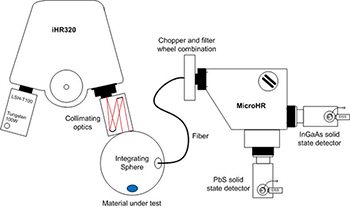
Characterization of photoresponsive materials, specifically those used in detector manufacturing, requires comparison between the novel material’s response to incident light with a known reference. HORIBA Scientific’s large catalog of available monochromators, adapters, and solid state detectors may be used in conjunction with an integrating sphere to characterize materials over a broad wavelength range from the UV to mid-IR. With the option for mounting multiple detectors simultaneously, there is no need to interchange reference detectors on the integrating sphere. In addition, integrated chopper and filter wheel adapters allow for both modulation of incoming light and separation of higher diffraction orders in a single package.
Absorption / Transmission / Reflectance

Absorption, Transmission, and Reflectance spectroscopy techniques are commonly used for determining the properties of materials. The modularity of an HORIBA Scientific spectroscopy system outperforms a traditional UV-VIS spectrophotometer by allowing you to expand your experiment capabilities. The interchangeable automated dual grating turret coupled with our motorized order sorting filter wheel, dual exit ports of the microHR, and a wide variety of light sources and detectors give the flexibility needed to cover all wavelength ranges from 180 nm to 20 microns.
Fluorescence

With HORIBA Scientific spectroscopy components, you can design a custom fluorometer using iHR spectrometers as the excitation and emission spectrometers with a choice of excitation sources, sample compartments and detectors from our full line of products and accessories. Complete system control is available through our SynerJY® software. HORIBA Scientific’s specialized Fluorescence Division offers a full line of dedicated, fully characterized spectrofluorometers and both time domain and frequency domain fluorescence lifetime instruments, featuring the world’s most sensitive instruments for research and analytical environments.
↑ top
Photoluminescence (PL)
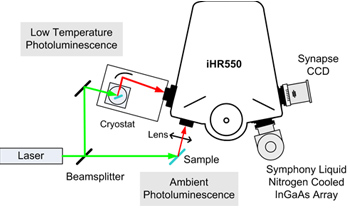
Photoluminescence is a simple yet powerful technique for characterizing semiconductor materials. An iHR550 equipped with a cooled CCD detector for the range of 400-1000 nm, and a cooled InGaAs detector for the 800-1600 nm range, is an excellent general purpose photoluminescence measurement system. Separate optical configurations can be designed for room temperature PL and low-temperature PL using the same iHR spectrometer. iHR spectrometers provide the flexibility to change experiments and optical configurations to meet your needs.
Plasma / Emission Analysis
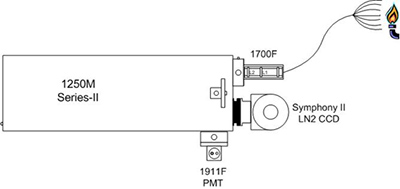
Simultaneous recording of spectra at multiple locations in a plasma can provide critical information about spatially varying phenomena. A fiber with multiple inputs can collect light from different points in the plasma and arrange the signals into a line of points at the entrance slit of the spectrograph. Taking advantage of the high resolution of a 1250M monochromator and high sensitivity of the liquid nitrogen cooled Symphony II CCD system, the spatially separated data is collected uniquely on the CCD and represents independent optical emission spectra from different fiber collection points.
Applications Notes

Related Equipment
Spectroscopy Tutorial
Learn more about key parameters of a spectrograph/monochromator
The Optics of Spectroscopy
A Tutorial by J.M. Lerner and A. Thevenon
- 2.1 Basic Designs
- 2.2 FastieEbert Configuration
- 2.3 CzernyTurner Configuration
- 2.4 CzernyTurner/FastieEbert PGS Aberrations
- 2.5 Concave Aberration Corrected Holographic Gratings
- 2.6 Calculating α and β in a Monochromator Configuration
- 2.7 Monochromator System Optics
- 2.8 Aperture Stops and Entrance and Exit Pupils
- 2.9 Aperture Ratio (f/value,f/Number),and Numerical Aperture (NA)
- 2.10 Exit Slit Width and Anamorphism
- 2.11 Slit Height Magnification
- 2.12 Bandpass and Resolution
- 2.13 Order and Resolution
- 2.14 Dispersion and Maximum Wavelength
- 2.15 Order and Dispersion
- 2.16 Choosing a Monochromator/Spectrograph
- 3.1 Definitions
- 3.2 Relative System Throughput
- 3.3 Flux Entering the Spectrometer
- 3.4 Example of Complete System Optimization with a Small Diameter Fiber Optic Light Source
- 3.5 Example of Complete System Optimization with an Extended Light Source
- 3.6 Variation of Throughput and Bandpass with Slit Widths